
Inside the system
The 22 Components of an Andale Glycol Beer System
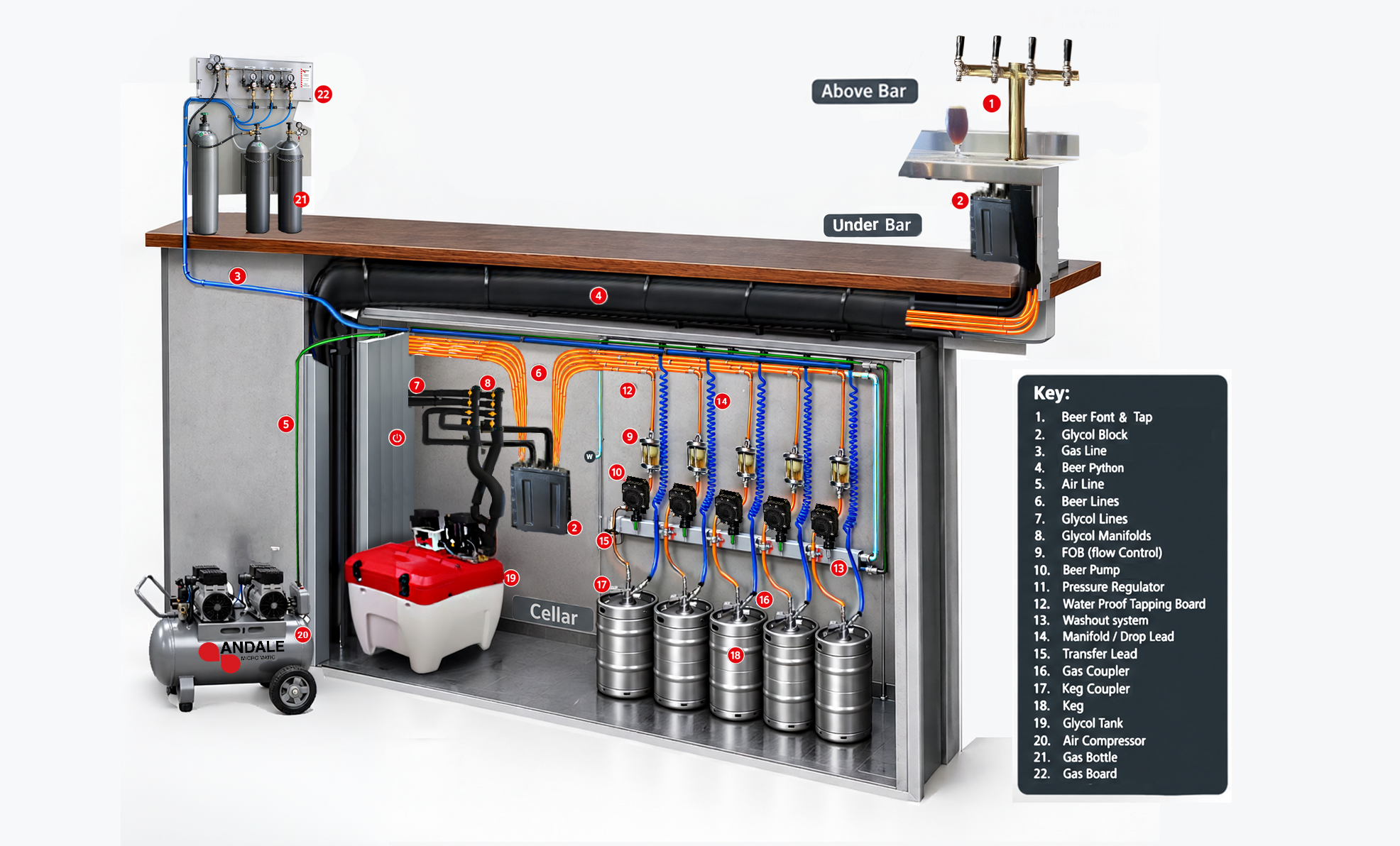
Every one of the 22 labelled parts in the diagram below is explained in detail, in the same order.
Beer Font & Tap — Andale’s Flooded Font
The flooded font was first introduced by Andale in the early 1990’s. A flooded font is any form of font where glycol or water can flow through the inside of the font, cooling and stabilising the drink within the font — helping ensure your beer is chilled right up to the dispensing point and preventing any possible ‘hot spots’ in your dispensing system.
More in the glossary →Glycol Block
A series of food grade stainless steel coils encased in aluminium. Glycol passes through the block and, using the conducting properties of aluminium, the glycol block acts as a cold reservoir to cool the drink and stabilise the system. It has no moving parts, generates no heat, and its compact size means it can be mounted behind glass racks or under the bar.
More in the glossary →Gas Line
The gas line carries CO₂ or nitrogen gas from the gas board through to the keg coupler, providing the pressure that pushes beer out of the keg. It’s food-grade tubing, colour-coded for gas rather than beverage.
More in the glossary →Beer Python
Beer python is a cluster of beer and glycol lines bundled together and wrapped in plastic to form a vapour seal, encased in insulated foam. The foam minimises heat gains over the length of the python. Andale’s beer python is made exclusively in our production facility in Somersby, NSW.
More in the glossary →Air Line
The air line carries compressed air from the air compressor to any pneumatically driven equipment in the system, such as an air-driven beer pump — a separate supply from the CO₂/N₂ gas line that pressurises the kegs themselves.
More in the glossary →Beer Lines
Beer lines are the food-grade hoses that carry beer itself from the keg, through the python, to the tap. Correctly balancing line length and internal diameter against the system’s pressure is what prevents foaming or a slow pour.
More in the glossary →Glycol Lines
Glycol lines run alongside the beer lines inside the python, carrying chilled glycol out to the glycol block and font and back to the tank. It’s this constant circulation that keeps the beer lines cold along their entire length.
Glycol Manifolds
A glycol manifold splits the chilled glycol supply from the tank out to multiple fonts, glycol blocks or cold plates, and collects the return flow back to the tank — letting one glycol tank serve several taps at once.
More in the glossary →FOB (Flow Control)
FOB stands for Foam-On-Beer. It’s a wall-mounted detector that stops the flow immediately when a keg runs dry, keeping the python full of beer and preventing ‘spitting’ at the tap.
More in the glossary →Beer Pump
An inline diaphragm pump that boosts beer pressure, not gas pressure. Beer pumps counteract pressure drop over very long line runs, ensuring proper flow when the keg is a long way from the tap.
More in the glossary →Pressure Regulator
A device that reduces the high pressure from a CO₂ or nitrogen gas cylinder down to the low pressure needed for dispensing beer. Regulating gas flow correctly is what prevents foamy pours.
More in the glossary →Water Proof Tapping Board
The waterproof tapping board is the panel inside the cellar where the beer and gas lines connect to their fittings and gauges. Being washable and weatherproof means it can be safely hosed down during routine cellar cleaning without damaging any connections.
Washout System
The washout system is a dedicated connection point that lets staff flush and clean the beer lines with cleaning solution without disconnecting the keg — making the regular beerline cleaning routine (see below) faster and more consistent.
Manifold / Drop Lead
A spiralled tube connecting the gas line to the keg. Drop leads give enough flexibility to correctly connect the gas line to the keg coupler regardless of the keg’s position in the cellar.
More in the glossary →Transfer Lead
The transfer lead is the short, flexible beer line section that connects the keg coupler to the main python — similar in purpose to a gas drop lead, but carrying beer rather than gas.
Gas Coupler
The gas coupler attaches to the keg’s valve, sealing the connection so pressurised gas can enter the keg and push beer out through to the font.
More in the glossary →Keg Coupler
A keg coupler connects the keg to the beer dispense system, allowing gas to enter the keg and beer to exit. Different breweries require specific coupler types (A, D, S and others) — using the wrong coupler can damage the keg valve or affect beer quality.
More in the glossary →Keg
A traditional keg is a pressurised stainless-steel container, typically 19–50 L, used to store and transport beer. Modern kegs have a spring-loaded valve on top and connect to the dispense system via a keg coupler.
More in the glossary →Glycol Tank
The glycol tank is usually placed in the cool room or cellar. It chills the glycol and circulates it through the python, font and glycol block and back again. Andale’s range of glycol tanks are made from moulded plastic to prevent rust or corrosion and are proudly Australian made — available in 3.5, 5, 8 and 10kW @ -10°C SST capacity, each with two pumps as standard (one on standby) and 70, 130 or 200 litre capacity.
More in the glossary →Air Compressor
The air compressor supplies compressed air to any pneumatically operated equipment in the system, such as an air-driven beer pump, via the air line.
Gas Bottle
The gas bottle is the compressed gas cylinder — typically CO₂, sometimes a nitrogen blend — that supplies the pressure for the whole system via the gas board and gas line.
More in the glossary →Gas Board
The gas board is the panel where one or more gas bottles connect to their regulators, from which pressure is distributed out through the gas line to every coupler in the system.
Planning your installation
Glycol tank vs self-contained unit
When we work with builders on a new installation, there are three things to confirm early: how much footprint the unit needs, where it can be placed, and what power supply has to be run to it. A standard glycol tank sits with its remote condensing unit, usually in the cool room or cellar; a self-contained unit houses the condenser in the same cabinet and can sit outside the cool room.


| Capacity | Glycol tank (L × W × H) | Self-contained unit (L × W × H) |
|---|---|---|
| 40L | 450 × 545 × 675mm | 680 × 570 × 1440mm |
| 70L | 450 × 840 × 1135mm | 580 × 780 × 1440mm |
| 130L | 600 × 760 × 1180mm | 600 × 760 × 1520mm |
| 200L | 680 × 570 × 1440mm | — |
- Glycol tank placement
- Inside the cool room or cellar, alongside the remote condensing unit
- Self-contained placement
- Outside the cool room — condenser is built into the cabinet
- Glycol tank power
- 10amp waterproof GPO at the tank, plus a dedicated 20amp circuit for the remote condenser
- Self-contained power
- 15amp — single connection, no separate condenser circuit
Allow clearance around each unit for airflow and service access, and have power installed by a licensed electrician. See the Coolgardie glycol tank and self-contained chiller range, or contact your nearest Andale branch for help sizing a system for your venue.